



Another workflow article about how your responses get folded in.
The ease of producing a season of Bonfireside Chat is directly tied to the subject material and each season, other than the first, has presented some challenges. I thought it might be interesting to lay out what was involved.
SEASON ONE: Dark Souls
For my money, this was the easiest season for a couple of reasons.
• Enthusiasm. We’re not over Souls or anything, but Kole and I started this show when we were both rolling in the deep, Adele style. But the deep in question is either the Abyss or the Depths. Pick your toxic. Kole came to Dark Souls before I did but what I lacked in punctuality, I think I made up in enthusiasm. I’m fucking voracious about Souls.
• An established body of lore. In an early episode of the show, Kole asks me if I’ve heard of Prepare to Cry, a question that would be ridiculous today. Yes, Dark Souls lore wasn’t a cottage industry like it is now but it was examined thoroughly and more information was coming to light all the time. This meant that, while we were free to indulge in lore speculation, a lot of the heavy lifting had been done by heroes like Vaati.
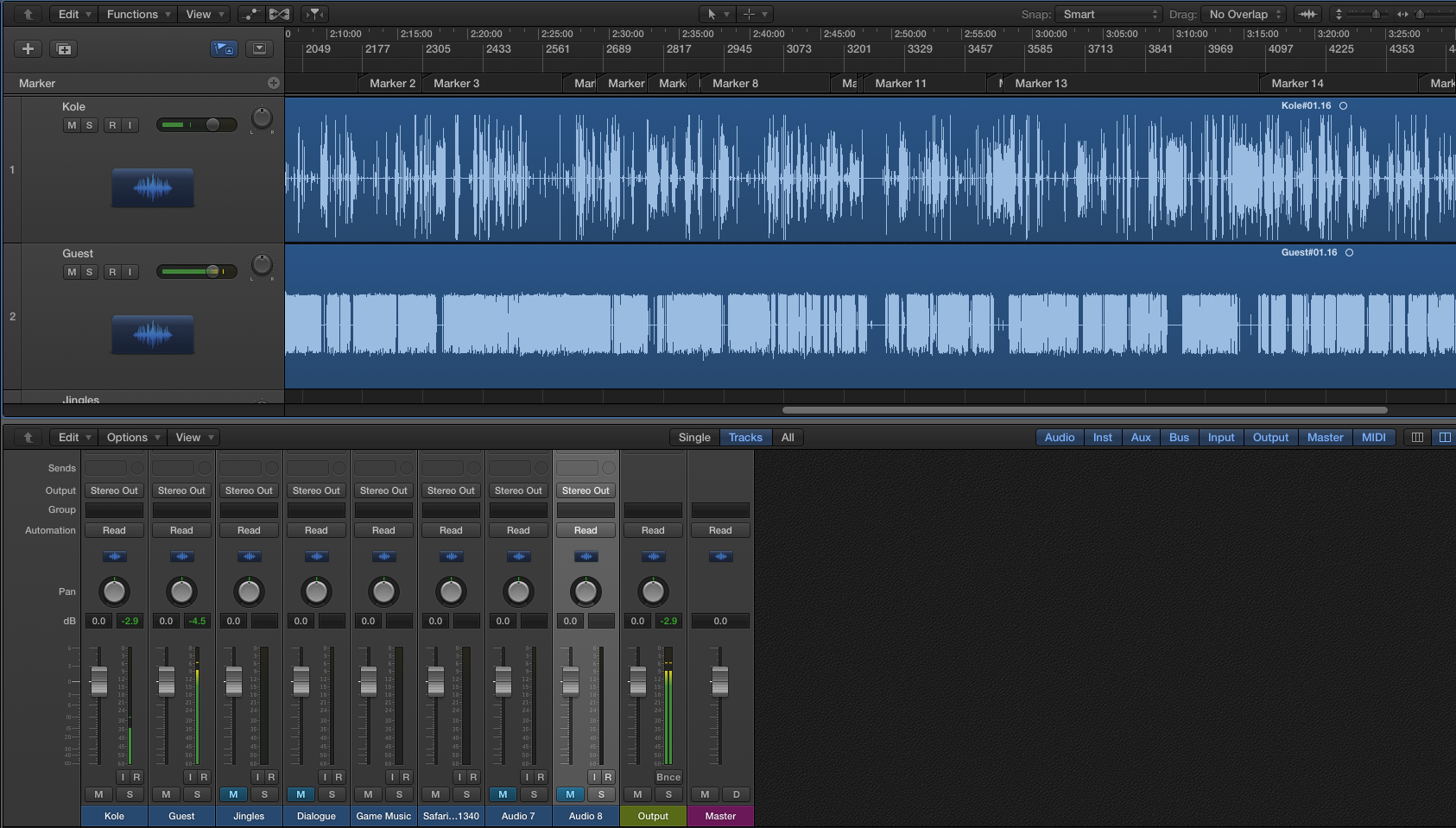
• The reason the game had been dissected so was because it was on PC. This meant that not only was there lore speculation but there was a ready source of sound effects and, most importantly, dialogue.
SEASON TWO: Demon’s Souls
Considerably tougher.
• Because it’s PS3 exclusive, there was so much less to draw on. Regardless of what they do on the business end of things, system exclusives are bad for games as art. The PS3 exclusivity reverberated throughout all aspects of producing the show. Dialogue was exceptionally hard to come by. Lore was scant. The game simply hadn’t been torn apart with any gusto. There were some exceptions, like once and future show alum VideoGameTalkingHead’s excellent work, but for the most part, information was confined to the backwood parts of gamefaqs message boards and reddit. Places where it smells like sulfur and there are milk solids in the whisky.
• It’s also worth noting that the game contributed to this. I don’t want to say that the lore in Demon’s Souls is worse but I think there is categorically less of it. Fewer characters with less backstory, more bosses that were just big meat bags and demons. The spots where this isn’t true, I think the season shined. For example, I love the conflict in talking about the ending or Maiden Astraea. Even if most fans don’t agree with me.
SEASON THREE: Origins
• Are people even interested in this stuff? The Souls community, while it unquestionably is bitchin’, is also very particular. Ask any youtuber that does Souls stuff what happens when they switch to other games. Epic Name Bro’s Souls videos have views that dwarf his excursions into other games. It isn’t because people don’t like Marcus, it’s because souls fans need to keep the drip feed going or they go hollow. So, it was risky to branch out into something that was tangentially related. This carried into our decision to eschew having guests. If I knew then what I know now, I would have asked Dave Klein to join us for an episode concerning The Ancient City, but doing each episode as a solo bolo has a distinct feel.
• Different media! I wasn’t sure how covering Berserk would go given that it is a game with very little interactivity. In fact, it’s little more than an extended cut scene! But we essentially took the same tact and it worked just fine.
• Less multimedia. Though there are some dialogue bits in the anime and movies, there was very little to draw on. King’s Field has exactly one bit of spoken word that we used. Because of this, the episodes were a bit flatter than previous seasons.
• One problem we didn’t have was the music. King’s Field has an EXCELLENT soundtrack. Berserk too.
SEASON FOUR: Dark Souls 2
• It’s early in the season but things are going well. The one issue is that lore is still being unearthed! This isn’t necessarily a bad thing but it does make this iteration of the show an evolving entity. I’ll definitely look back on it after we’ve finished, before, most likely, Origins Volume 2, but for now, the jury is out. What do you think?
The WOFF! formula came about pretty naturally. As we poked and prodded different early games, we discovered what made for good episodes and what was a little more difficult. Since we’re essentially a book club, we tend to gravitate towards games with a strong narrative focus. When that’s not available, we hope that we can focus on deep mechanics. This doesn’t always happen, however. Take, for instance, our episode on Zombies Ate My Neighbors. I like that game a lot, I like that episode, but it was a challenge to record because we’re used to dealing with plot beats in tandem with gameplay. If you look back on our episodes, any game that lacks a strong story (Mario games, Sonic, Heroes of Might and Magic) makes for a different feeling episode. Not necessarily worse but different.
What this means is that there are games out there that I think are worth talking about, that are absolutely fantastic, overlooked or otherwise noteworthy that, sadly, would make lousy episodes of the show. Like The New Tetris. This 1999 Tetris variant is my favorite puzzle game. I love Bust-A-Move until my colorblindness makes it unplayable. Peggle is chaotic bliss. Lumines is a flawless synthesis of visual and audio style. But The New Tetris is truly something special.
Tetris has been called a perfect game. And I’d recommend watching that video because I think his points are more or less inarguable. But Tetris didn’t truly gain my love until it was “New.” If you’ve never played this variant, I’ll break it down for you. Regular Tetris rules apply with one added wrinkle: creating a perfect 4x4 “block” of tetronimoes causes the block to solidify. If you construct one out of all different kinds of blocks, you get a shameful graphite colored compromise. BUT if you manage to create a block out of four of the same kind of block (possible with every shape other than those shitty Zs) then you get a gold block. When you clear a line with one of these blocks, you get a score multiplier. Silver is shitty, gold is great. Got it?
What does this do? It adds an entire dimension to the game. Not like those shitty Tetris Axis games, no, it adds an element of risk and reward. Do you keep your lines down? Fine. Play it safe. Non flavored for you. Why don’t you go home to your regular hummus and white bread and just die already. But for the true challengers of the unknown, every piece presents you with a choice. Do you make the line or hold out for the piece you need to create your golden god? Oh lord, how many more “Z”s do I need to endure, Job-like, before you grant me the “L” I need? Just one more piece. I can hold out just one more piece… This element has always been a part of Tetris because of the long block but by ramping up that tension, you, well, ramp up the tension. And that's a good thing
Other design new additions complement this. The game gives you a preview pane of three pieces rather than one. If you see that “L” on the distant horizon, you’re already planning what to do with your current piece and the next two in order to not fuck up your square. You’re considering multiple angles, all while dealing with the grim inevitability of never ending falling blocks. It introduces shaky human chaos into the ecstasy of order and for that, I’ll always love it.
See, perfection is sort of boring. A guiding philosophy of WOFF! is that it’s not a greatest hits tape. Sure, every once in a while we grabnab a slab of Link to the Past to remind ourselves that perfection exists. But we spend a lot more time in the flawed gems and questionable nostalgia categories and that’s where our best episodes come from. Perfection doesn’t inspire passion. It’s curse is that it comes out of the box already being taken for granted. Like Mathewmatosis says, when was the last time you heard a serious examination of the elements of tetris?
Now, we could do a split EP episode with New Tetris but it’d more or less be the content of this blog. There just isn’t enough to say about it other than that it’s fucking excellent. Try it! Go ahead, I’ll wait. What? Can’t find it? That’s right! It’s fucking tragic! Not only is this game hard to find but to my knowledge, this game mode has only been re-released on the largely disappointing Tetris Worlds release which includes, I might add, that shitty permanent spinning thing. You might have to google this game to play it but I think you’ll be glad you did.
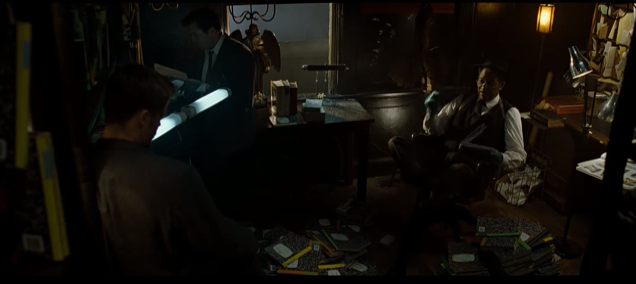
Click for an exclusive look inside Kole's apartment.
I've considered streaming the games I play for Watch Out for Fireballs!, but it would be unwatchable. Not strictly because I'm bad at games -- which I am -- but because I constantly stop to take notes... and that's bad television.
The banner image you see above is a photograph of the notes I took for our recent episode on Killer7. In total, I filled eight 7.5" x 10" pages in a leather-bound pretentious artist's notebook (gridded, obvs).
Writing things down is a habit I've nursed for a long time. Getting information out of my head calms me down. Turns out, this is incredibly useful when you're playing a 20 hour game, and then talking about it for 3 hours.
Watch Out for Fireballs! was always supposed to be a book club for games. Excepting the tweet that started this endeavor (my proposal that we do a 30 minute podcast about retro games), the show has stayed true to that initial pitch. We want to talk about the experience of playing these games, good or bad, and draw broader conclusions from the tiny details. For that to happen, the tiny details need to be captured.
I play each game with my notebook at my side. Whenever something happens that I want to remember, I write that down. This can be events in a cut scene, something weird about the play of a particular area, or a comparison or summary that pops to mind. This is also useful in adventure games for puzzle notes, and such.
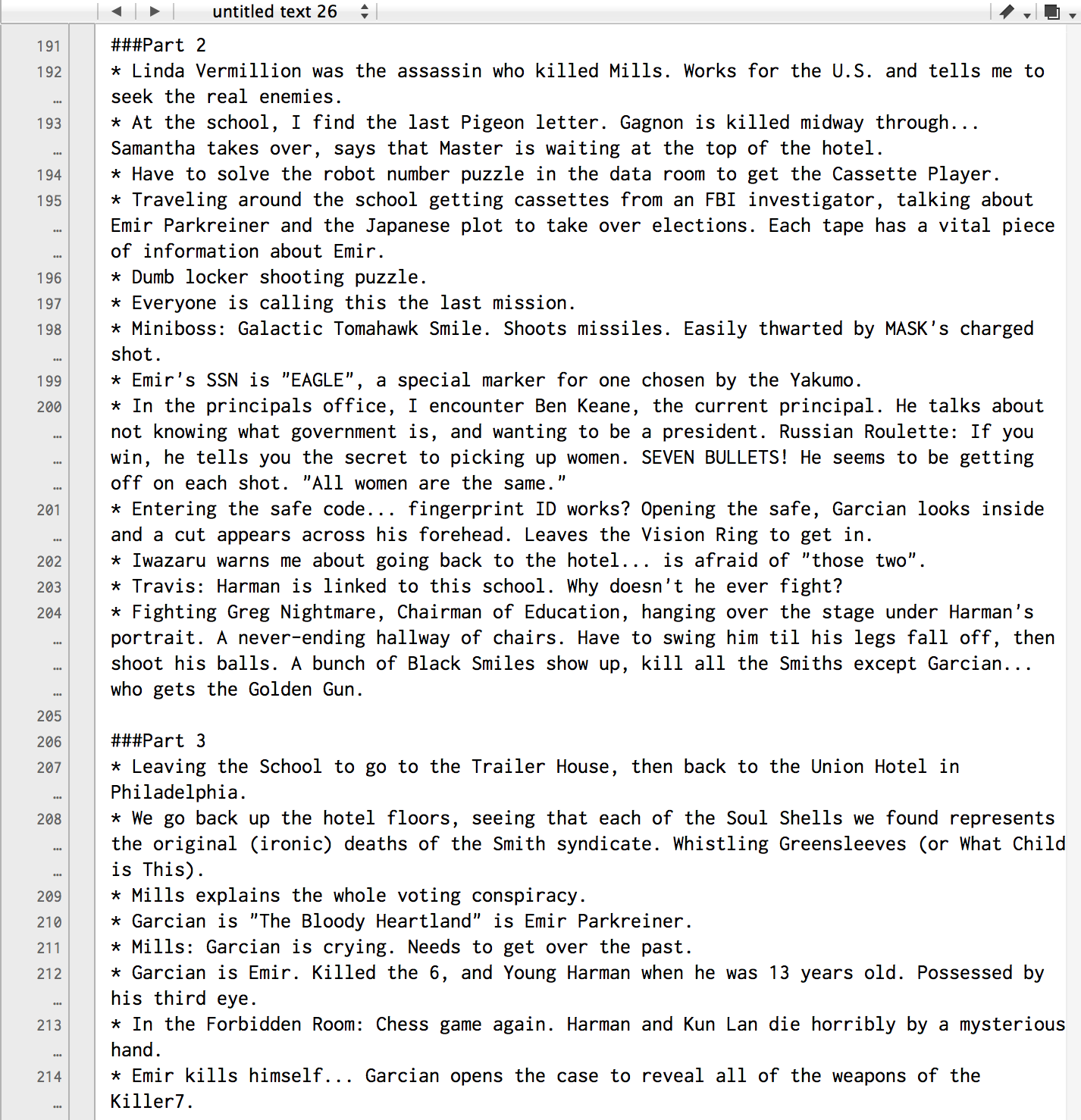
I do all of my writing in BBEdit with Markdown.
This doesn't sound so spectacular, but these notes aren't the ones we directly refer to on the show. Prior to each recording, I transcribe my handwritten notes into a Markdown outline for reference on the show. The process of poring back over the notes, discarding the irrelevant ones, and putting everything into a structure that reflects the experience of play (in a way that's easy to talk about) helps me prepare to talk about the game in an extemporaneous way.
Wha? Yep. The notes work best when we don't have to use them at all. I write it down so I don't have to read it back. For as much time as we spend in the weeds, it might be surprising to find out that we spend very little time referring to these exhaustive bullet points.
The final outline is a great safety net, always open in front of us if we need a quick refresher on what happens when, or if we need to pull the ripcord and find a new topic. Exhaustive notes and conversational tone aren't mutually exclusive. In my experience, they support each other.
Other things make their way into the notes during this process. I do the research for the opening paragraphs of each episode during the note-taking time, looking for facts and relevant pieces of information. I also write up the plot summaries, where applicable, and collect/edit all of the responses for a particular episode.
Pre-production and preparation are important to our process and format, and it feels good to capture all of these thoughts and file them away in my journals and on the show. It's time consuming, but absolutely worth it when an episode goes well.